

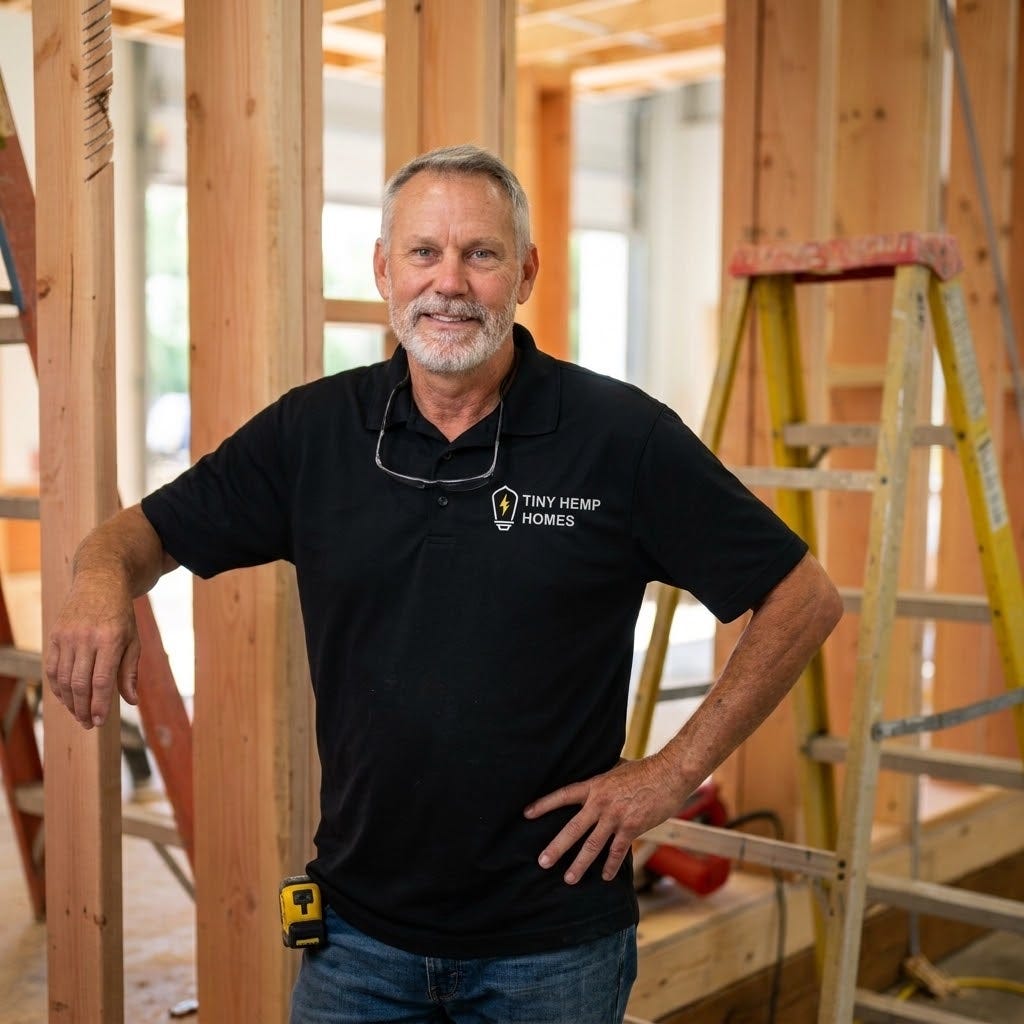
Wade Atteberry was brought on as project manager for Oregon State University’s “Train the Trainers” workshop with an ambitious assignment: create a single demonstration build capable of showcasing the expanding range of industrial hemp building materials and construction methods now emerging in the U.S. The month-long build ultimately brought together what Atteberry counts as 12 distinct hemp-based materials, feedstocks and applications within the project and his accompanying modular-home display. With no engineered architectural drawings to work from, Wade had to design on the fly—developing different framing methods, adapting the structure as the build progressed, and finding ways to incorporate everything from hand-tamped hemp-lime and blocks to structural panels from Homeland Hempcrete. What emerged was not simply a demonstration building, but a hands-on exploration of just how many ways hemp can now become part of a building.
From June 1–5, the Hemp Construction Train-the-Trainer Workshop transformed Oregon State University’s Precision Agricultural Systems Center into a living laboratory for the future of hemp construction. Organized through OSU’s Global Hemp Innovation Center (GHIC) and supported by a USDA National Institute of Food and Agriculture (NIFA) grant, the workshop was led by Dr. Jeffrey Steiner, Director of the Global Hemp Innovation Center in OSU’s College of Agricultural Sciences, and Dr. John Simonsen, Professor of Wood Science & Engineering in the College of Forestry and GHIC faculty leader for Building Products, Construction & Digital Architecture. Together, they helped create a rare meeting ground between university research and hands-on industry expertise, bringing nine leading North American hemp construction companies together to train 10 selected tradespeople—eight of whom were Native American or Native Hawaiian builders representing communities and institutions including the Yurok Tribe, the Warm Springs Reservation, and Stone Child College.
At the center of the event was a 10-by-20-foot demonstration structure designed and led by Wade Atteberry, founder of Tiny Hemp Homes. Contracted by OSU, Atteberry leveraged his deep experience as a builder and material experimenter to execute an complex challenge: create a single structure capable of demonstrating multiple hemp construction technologies in one place, while serving as a hands-on classroom to empower tribal builders to bring these skills back to their communities.
Inside those 10 by 20 feet, hemp appeared in panels, hand-tamped walls, blocks, sprayed insulation, plant panels, batt insulation, and flooring.
As Atteberry explained, the objective was to showcase all the different types of hemp building materials that are now available in the U.S. market and best practices for each.
The workshop marked a historic milestone likely the first time in the United States that this many hemp construction technologies were demonstrated in one place offering a rare glimpse of an industry moving beyond the idea of hemp as a single building material.
Rather than asking which single technology would dominate, the workshop posed a broader question:
What if the future of hemp construction isn’t a single winning system, but a family of systems working together?
We sat down with Wade to dive into the technical components explored each day of the workshop and better understand the materials, practices, and educational significance of this monumental event.
From Crop to Component
Beginning the workshop with manufactured bio-based insulative panels demonstrated something profound about where hemp construction is heading.
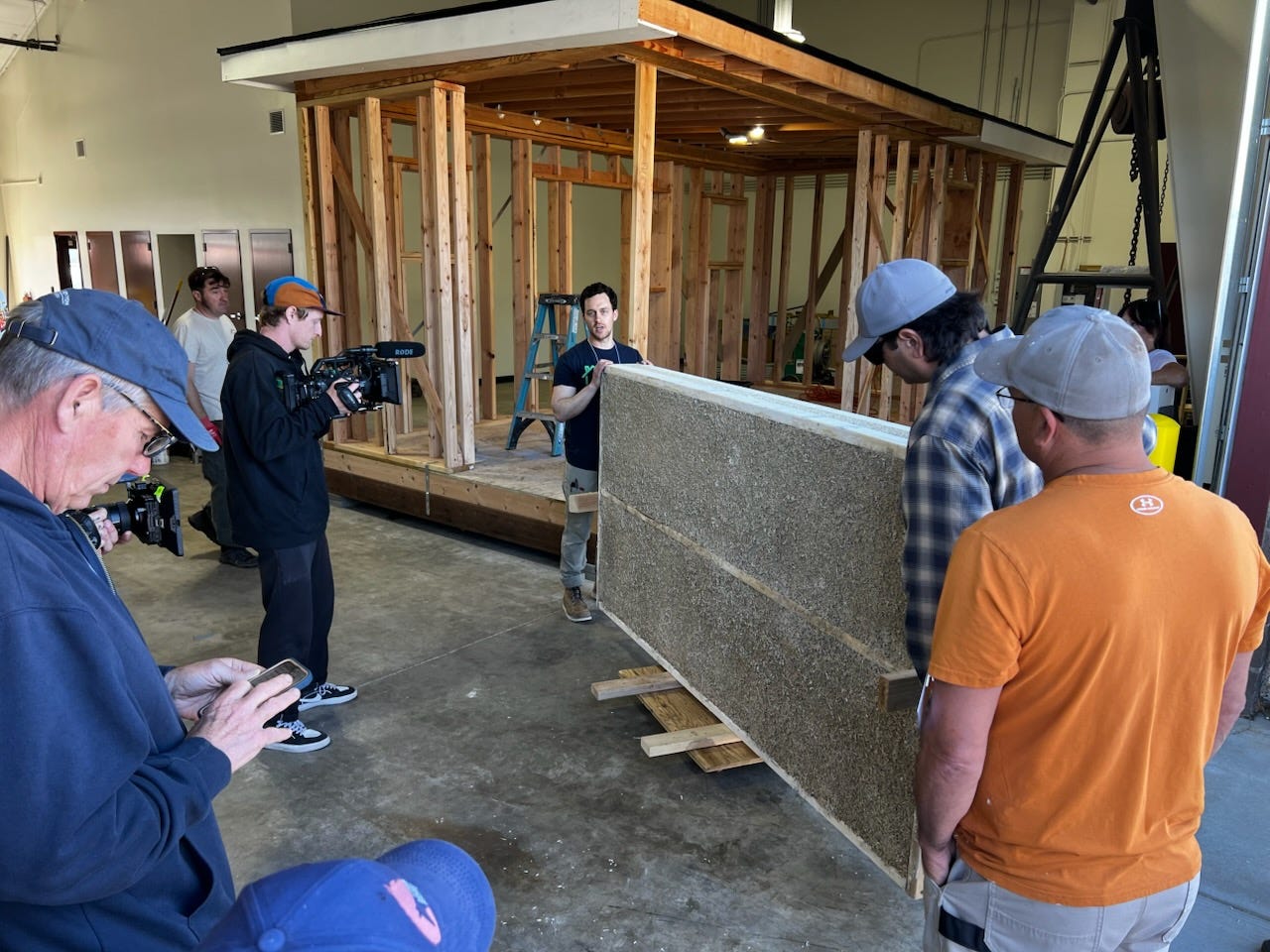
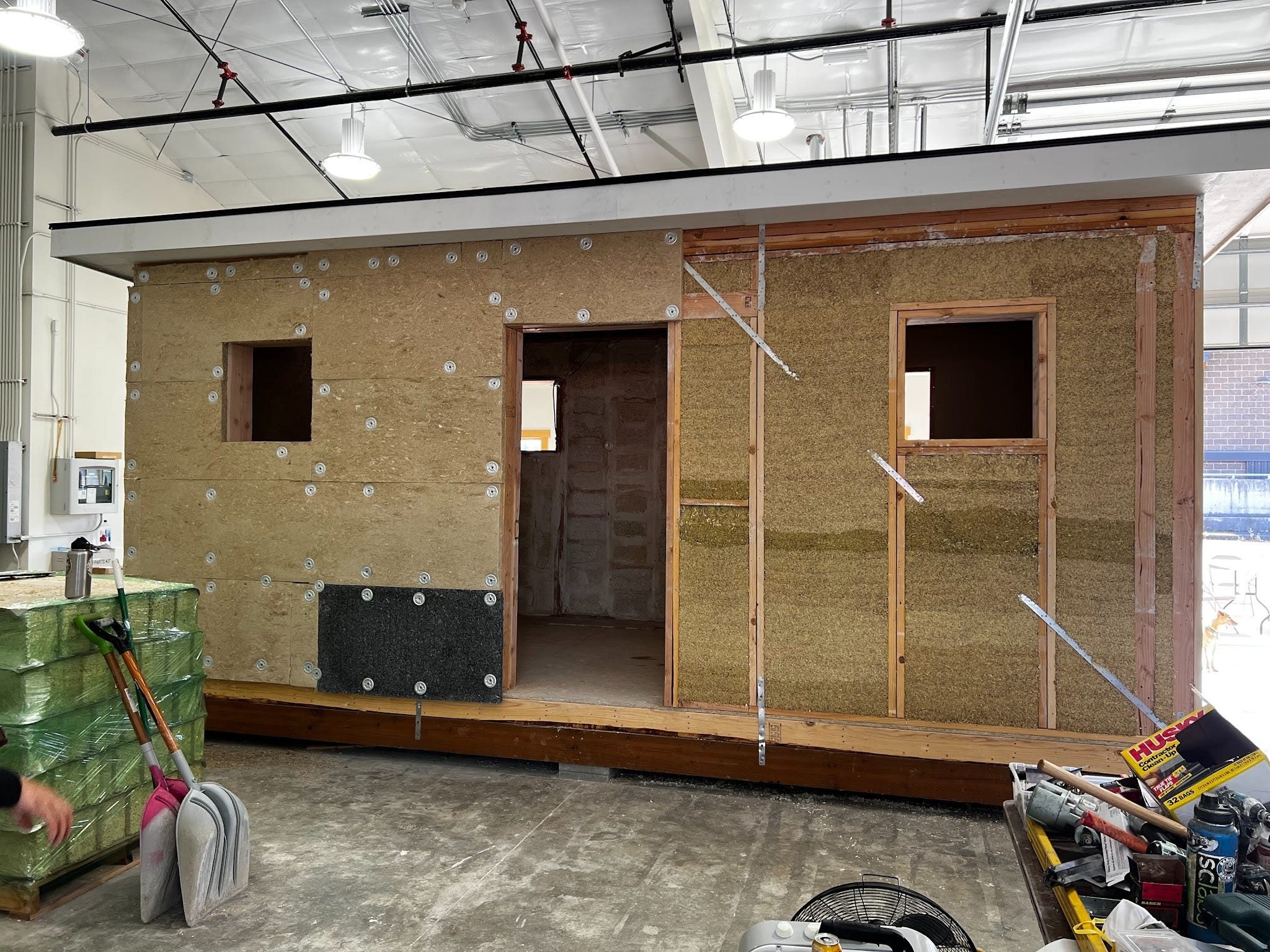
On day one, the first system installed was Homeland Hempcrete’s pre-fabricated hempcrete panels, bringing a distinctly different construction logic into the building—pre-made, cured, and dried off-site, then slipped into place beneath a propped roof. Four people could lift and position them. Because they arrived already dry, a plaster demonstration could begin almost immediately.
Atteberry explained,
“Unlike site-mixed materials, manufactured panels arrive pre-cured and ready for assembly. This eliminates job-site lime exposure and dramatically speeds up construction.”
It is one thing to demonstrate that hemp can become a useful building material. It is another to demonstrate that hemp can become a manufactured modular building product: something produced to a defined form and incorporated into a repeatable construction process.
That was the first lesson of the week.
The agricultural material could leave the field and eventually arrive at a construction site looking less like raw biomass and more like something the conventional building industry already understands: a component designed to become part of a building.
And that distinction is important to the larger story of hemp construction. The question is no longer simply whether hemp can be used to build walls. It is whether hemp-derived materials can be processed, engineered, manufactured and delivered in forms that fit into the increasingly sophisticated workflows of the construction industry.
The significance of the OSU demonstration, however, was not that panels replaced other hemp-building methods. It was that they occupied the same building right alongside them.
As the week unfolded, the panels became the first piece of a much larger picture: hemp construction is not converging on a single material or method. It is developing into a family of building systems, each with different manufacturing processes, installation requirements and potential applications.

From Field to Form: Variable Hurd and Hand-Tamping Techniques
Day Two moved in the opposite direction from the opening day. Instead of beginning with a finished, manufactured component, the workshop stepped back to the agricultural feedstock itself.
The primary focus of the day was hand-tamping or “cast-in-place”—what Wade Atteberry sometimes calls the “hippie method”—which provides one of the most direct pathways from crop to wall. Participants mixed hemp hurd with a lime-based binder and water, placed it into forms, and compacted it by hand. This hands-on process highlighted how multiple emerging, viable methods exist for building with hemp, ranging from automated industrial blocks to manual site-cast applications.
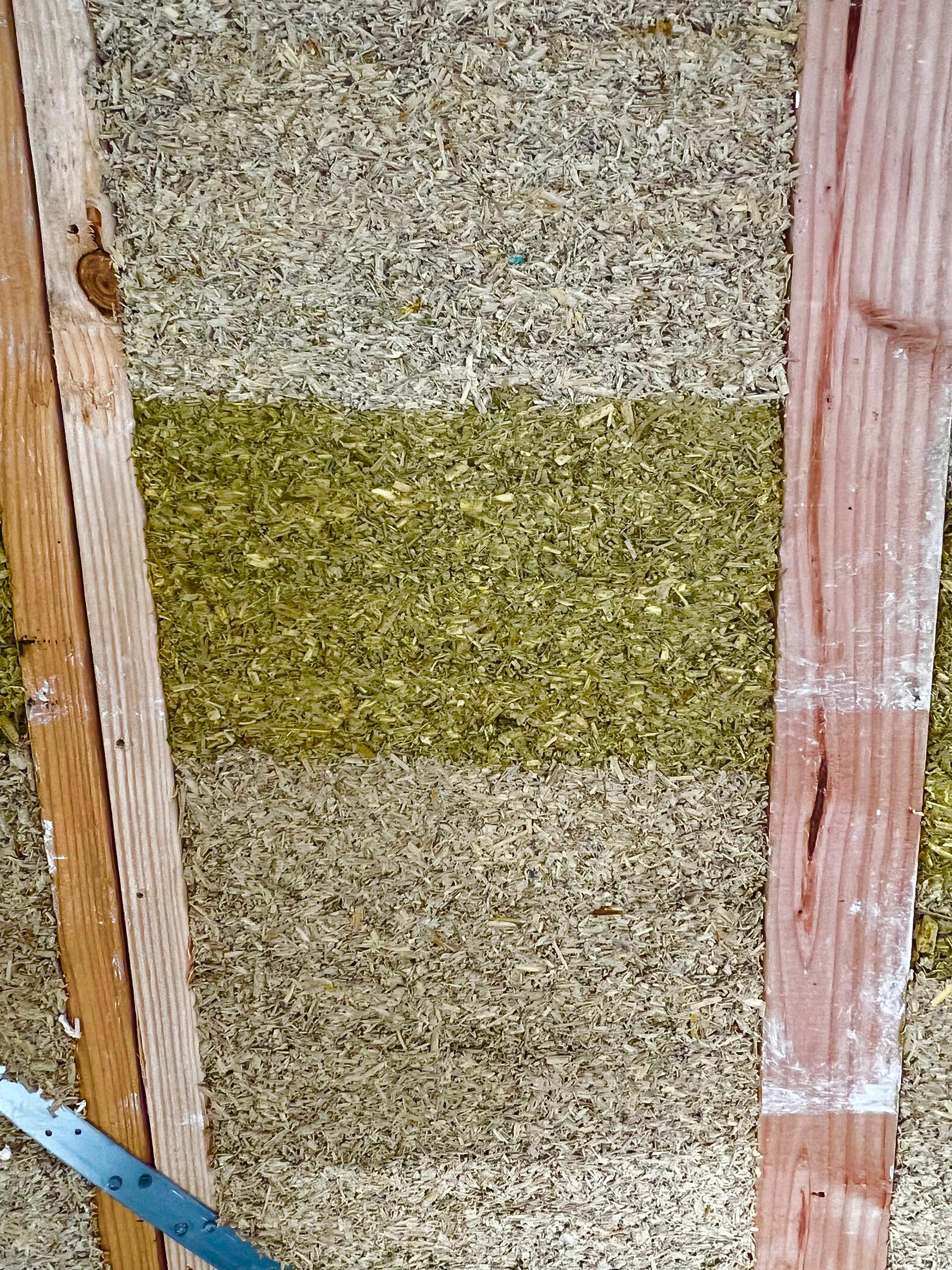
Hempcrete expert Sergiy Kovalenkov, founder of Hempire, compared four different types of hurd used during the workshop. Sourced and processed in different ways, the materials exhibited visibly different particle sizes, cuts and overall consistency—giving participants an unusually direct opportunity to see how variable the agricultural feedstock itself can be before it ever becomes part of a wall.
Among these, the most notable material was Atteberry’s silage-cut industrial hemp from California’s San Joaquin Valley. This unique processing technique takes place directly in the field, without the need for a decortication facility. The “silage-cut” whole plant hemp material is cut down with a sickle bar, left to dry in the field for 1-2 weeks, and then scooped up with a silage cutter, chopped and blown into a truck driven to the barn and bagged as whole plant, silage-cut industrial hemp. This demonstrated how variable agricultural methods directly influence the final material’s texture, workability, and tamping consistency.
Atteberry recalled the pivot to local agricultural adaptation:
“Hurd is typically a biproduct from the fiber industry, of which we really don’t have customers for in California, so we needed to pivot in order to have material to build our Tiny Hemp Homes. I came up with this method— which is far cheaper to produce, requiring only a field— no factory.”
Working directly with these diverse hurd inputs alongside different framing configurations illustrated that the performance of a hemp-lime wall is not dictated by a single standardized formula.
In other words, the building material carries a history.
Plant → Harvest & Cut → Processing → Particle Size & Consistency → Mix Formulation → Hand-Tamping Installation
At OSU, that chain became visible inside a wall.
Participants were not simply learning how to fill a form with hemp-lime. They were seeing how decisions made in agriculture and processing can eventually become decisions made in architecture and construction.
That is where hemp building becomes a material-science story as much as a construction story.
And it points to one of the less obvious challenges—and opportunities—of building with carbon-negative, agricultural materials: the finished building product does not begin at the factory door. It begins much earlier, in the field, in the harvest and in the processes used to turn a crop into a consistent material that builders can depend upon.

Precast Blocks: Speed, Versatility, and Job-Site Applications
By the third day of the workshop, the demonstration structure shifted away from site-mixed wet applications to explore the practical advantages of precast block systems.
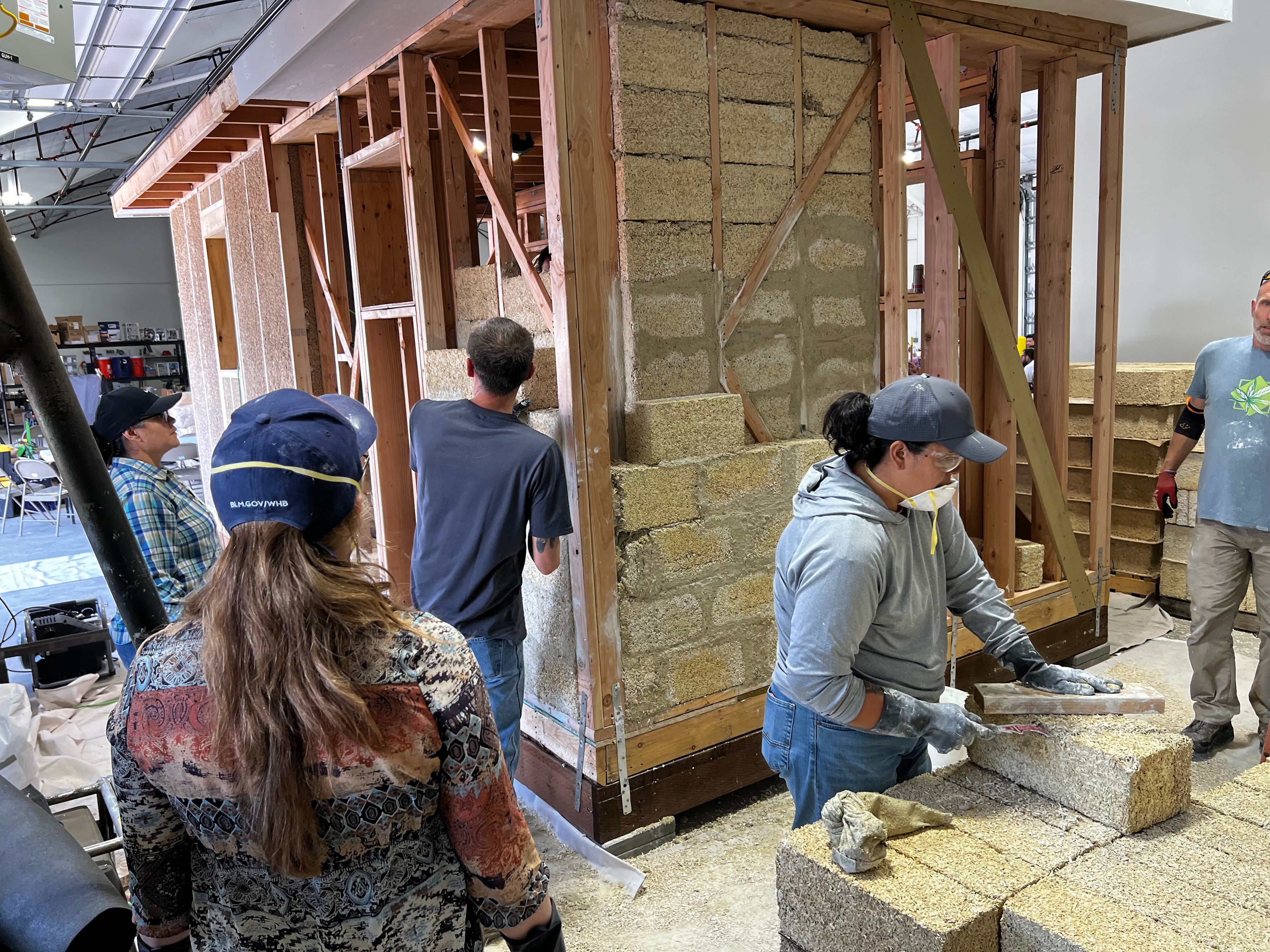
While hand tamping offers a direct pathway from crop to wall, precast blocks address a completely different set of job-site constraints. The primary benefit comes down to timeline: because precast blocks arrive pre-cured and dry, builders can apply a finish plaster coat immediately after installation rather than waiting weeks for a wet-mixed wall to dry out. As Wade Atteberry highlighted, this makes block systems particularly effective for building retrofits and remodels on existing homes. Furthermore, the fundamental mechanics of binding plant fibers into blocks represent a time-tested approach that applies not just to hemp, but to agricultural byproducts worldwide.
Rather than presenting a single standardized block, the workshop showcased four different framing methods, and how the various block geometrics integrated into each method:
Pre-cured hemp blocks brought by Dion Lefebvre and Gina Engel of Eighth Fire, designed with extending "tails" that allow the units to fit between wall studs while wrapping around the exterior framing.
Wade also describes “Thin Exterior Cladding Blocks” used in the demonstration. These were “Standard 2-to-3-inch thick units” (measuring roughly 8 by 12 inches) built to mount directly onto the outer face of the studs to create an exterior layer without thermal bridging.
Attendees also experienced installation of Non-Hemp Structural Foundation Blocks: a dedicated structural block system (not made from hemp, but woodchips - another industrial waste product capable of producing high-strength units) brought by Joseph Becker, of Faswall, in Oregon, demonstrated how traditional load-bearing masonry can serve as a durable foundation paired alongside hemp-lime wall assemblies.
Seeing these options side-by-side reinforced that natural building is not about finding one winning product. Instead, as Atteberry noted, hemp’s versatility enables a range of materials that each have their own ideal place in a build.
From Building with Hemp to Manufacturing with Hemp
Day four brought the workshop face-to-face with one of the hardest questions confronting any emerging building material:
How do you move from something that works to something that can be made repeatedly?
Spray application begins to change that equation.
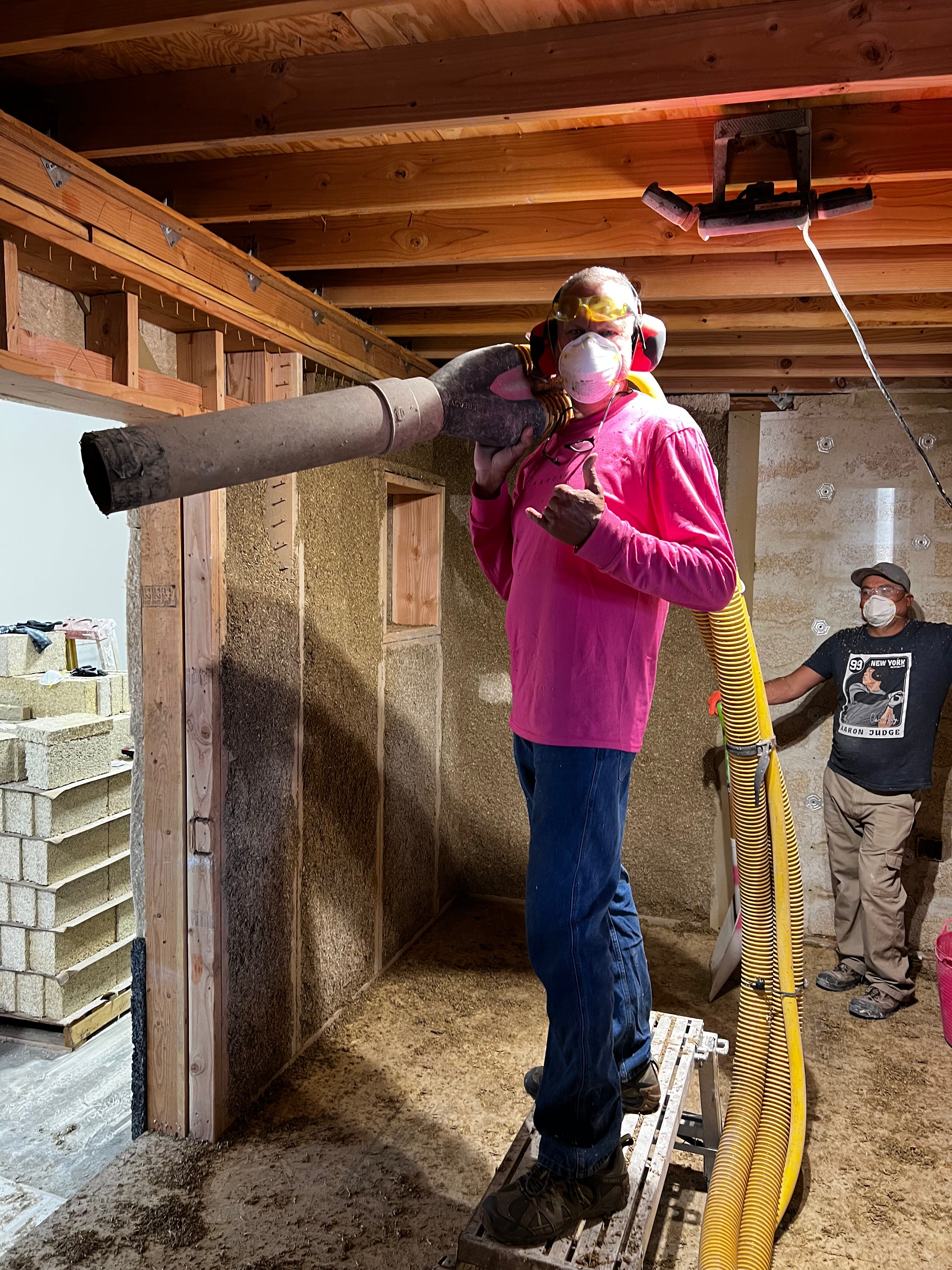
Aaron Grail of Aaron Grail Construction, and Cameron McIntosh, co-founder of Americhanvre Cast Hemp , an exclusive U.S. licensee of the Baumer EREASY Spray Applied Hempcrete system, brought the equipment to OSU to demonstrate a different approach to applying hemp-lime.
Rather than placing material into forms by hand, a trained crew can mechanically apply the mixture and build up an assembly much more rapidly. Spraying against Hempitecture’s Plant Panel X, demonstrated that builders can spray against a permanent form and then finish with plaster.
But Atteberry is careful not to confuse faster with easy.
“Spraying is a lot faster. It takes a very experienced crew to run the sprayer. There is a steep learning curve and it takes time.”
That distinction matters.
The moment hemp construction moves from hand-applied material toward mechanical application, another layer of technology enters the process. The equipment has to be learned, calibrated and controlled. The material has to behave consistently; and the people operating the system have to understand how the machine, the mix and the building assembly interact.
Atteberry describes the equipment itself as part of that ongoing process of refinement:
“It’s a super technical machine, and requires experienced skill and maneuvering. This is probably its third, maybe fourth, actual generation. And it’s going to keep evolving, so it’ll get better and easier.”
For an industry still developing its manufacturing infrastructure, that may be one of the most revealing moments of the entire workshop.
Innovation rarely arrives fully finished.
Sometimes it looks like a machine in its third or fourth generation, operating inside a university laboratory, solving problems in real time while its remaining limitations are still visible.
And spray application reveals something fundamental about manufacturing: consistency becomes increasingly important as production scales.
Feedstock preparation matters. Water content matters. Environmental conditions matter. Operator experience matters. Process control matters.
The closer a material moves toward industrial production, the less room there is for uncontrolled variation.
That is why, for Atteberry, the next step is not simply developing a faster way to spray hemp. It is integrating that capability into a repeatable manufacturing process:
“When we talk about going to scale, you can envision why having this machine set up in a factory to make structurally integrated panels is key.”
That idea reaches beyond the machine itself.
It points toward a larger transition now taking shape within hemp construction: from building with a material toward manufacturing a building system.
And that may be one of the most important thresholds an emerging material industry has to cross.
A promising agricultural feedstock can demonstrate remarkable possibilities. But broader adoption requires something more demanding: reliable processing, repeatable products, specialized equipment, trained workers, quality control and manufacturing systems capable of delivering the same result again and again.
At OSU, the spray demonstration offered a glimpse of that next stage—not as a finished destination, but as a technology still being refined in the hands of the people developing it.
The question was no longer simply whether hemp could be built into a wall.
It was beginning to become a question of how efficiently, consistently and intelligently an entire building system could be manufactured around it.
Wade Atteberry has developed a $250k spray machine designed to do just this. Utilizing this spray technology with his “silage-cut” hemp in a factory setting enables mass - production of his modular Tiny Hemp Homes.
Can Hemp Materials Work Across the Whole Building?
What happens when hemp moves beyond the walls and into floors, ceilings, insulation and finishes?
By the final day, the structure had become difficult to describe simply as a “hempcrete building.”
HempWood flooring was installed. Hemp batt insulation was demonstrated in the ceiling. A newer plant-panel product appeared in several applications—including as a substrate for spray application and as a surface capable of supporting insulation and plaster.
The demonstration revealed something that had been building throughout the week: hemp was no longer showing up as a single material or construction technique. It was appearing in different forms, performing different functions throughout the building.
One of the more intriguing demonstrations involved using the plant panel as a ceiling substrate. Atteberry showed how the product could potentially provide a surface for plaster without first covering the ceiling with conventional sheetrock.
As he put it:
“That product now makes it so you can plaster a ceiling without putting sheetrock or secondary layer on it to plaster.”
He connected that seemingly simple construction detail to the larger evolution he sees taking place in the industry:
“So that’s another leap forward in the industry to be able to now have the whole envelope done in lime plaster.”
That matters because a building envelope is not one thing. It is a layered system, with walls, ceilings, insulation, surfaces and finishes performing different functions together.
By Friday, the OSU structure offered a glimpse of what happens when hemp-derived materials begin occupying several of those roles at once.
Flooring. Panels. Insulation. Wall systems. Spray-applied material. Finishes.
The range extended even further in Atteberry’s traveling modular-home display wall, where less obvious uses of the plant appeared within the finishes themselves. The assembly incorporated hemp biochar, a woven hemp-canvas mesh within the plaster scratch coat, and fine hemp hurd particles in the second plaster coat.
These details were easy to overlook beside the larger blocks, panels and spray equipment, but they reinforced the same lesson at a much finer scale: different fractions and forms of the hemp plant can potentially serve very different functions within the same building—from major wall assemblies and insulation to reinforcement, additives and finishes.
The significance was not that every building should use every hemp product. It was the expanding range of ways the plant can be processed, engineered and incorporated into construction.
What began on Monday as a collection of individual technologies was starting to look more coherent: a developing family of building products capable of working across different parts of the same structure.
When asked when hemp stops being thought of simply as “hempcrete” and begins to represent something broader, Atteberry offered the terminology he prefers:
“I like to call it CARBON NEGATIVE hemp building materials.”
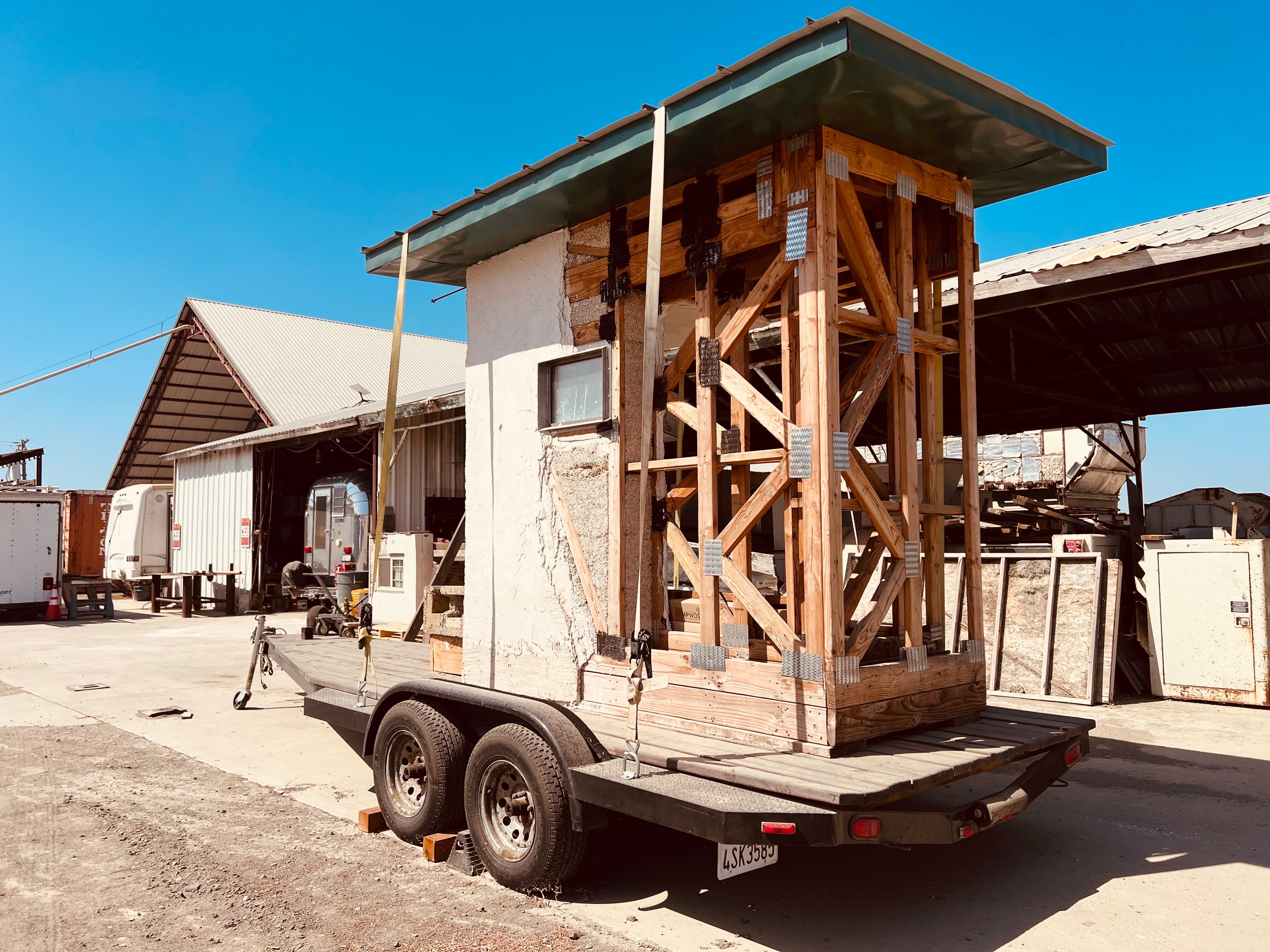
Reflecting Atteberry’s motto for Tiny Hemp Homes’, “Yes, we can build our way out of the CO2 climate crisis!”
Whether an individual product can substantiate that characterization ultimately depends on product-specific testing and lifecycle assessment. But the phrase captures the larger shift Atteberry was pointing toward.
Hemp building is moving beyond the image of a single wall-filling material and toward something much broader: a range of materials, each capable of serving a different purpose within the building.
Taken together, Atteberry counts 12 distinct hemp-based materials, feedstocks and applications represented across the demonstration and his traveling display—from different hurd inputs and construction systems to panels, insulation, flooring and hemp incorporated directly into plaster assemblies.
The number itself may be less important than what it represents.
After five days inside a 10-by-20-foot structure, the lesson was increasingly difficult to miss:
The possibilities of hemp building may lie not in one material, but in how many useful forms the plant can take.

Five Years Later, A Different Industry Is Taking Shape
For builders who have watched hemp construction develop first-hand, how much has really changed?
Standing inside the demonstration, Atteberry could see another story written into its walls: how much the available materials and technologies had evolved in only a few years.
His assessment was immediate:
“The quality of the blocks, the quality of the batt insulation, the panels, the next generation spray machine, have all advanced. The only thing that really hasn’t changed is the hand tamping.”
Hand tamping remains what Atteberry calls the industry’s “old faithful”—a relatively direct method that has persisted while much of the technology surrounding it has continued to develop.
The blocks have changed - there are companies now making structural hempcrete blocks! Insulation products have changed. Panels have changed. Spray equipment has changed. And alongside them has come a growing ambition to manufacture hemp building materials more consistently and at greater scale.
For Atteberry, the pace itself is striking:
“From five years ago to today is a huge evolution that’s happened. And I think in the next two years we’ll have just as much advancement that we did in the last five as more and more people start adopting this…”
The future portion of that statement is Atteberry’s prediction. But the first half could be seen throughout the OSU structure itself.
The conversation is changing.
The question is no longer only whether these materials can work. Increasingly, the questions are whether they can be manufactured consistently, supplied reliably, specified confidently and installed by a growing workforce with the knowledge to use them well.
Those are different questions.
They are the questions that begin to emerge when promising materials start becoming an industry.
The evolution unfolding at OSU was also being documented beyond the workshop itself.
Atteberry invited documentary producer Clayton Lindley to Oregon, where Lindley and his film crew spent all five days capturing the workshop as part of a hemp documentary he has been developing for the past two years. Rather than filming only finished products, the crew followed builders, manufacturers and trainees as they worked through different approaches to building with hemp.
For Lindley, being immersed in the workshop added another dimension to the story he had already spent two years documenting.
“Personally, I learned a lot from just being there, but it added a valuable perspective for the final film.”
The cameras captured another part of what made the workshop unusual: an emerging industry learning from itself in real time.
The Building is Finished— But the Next Chapter is Not.
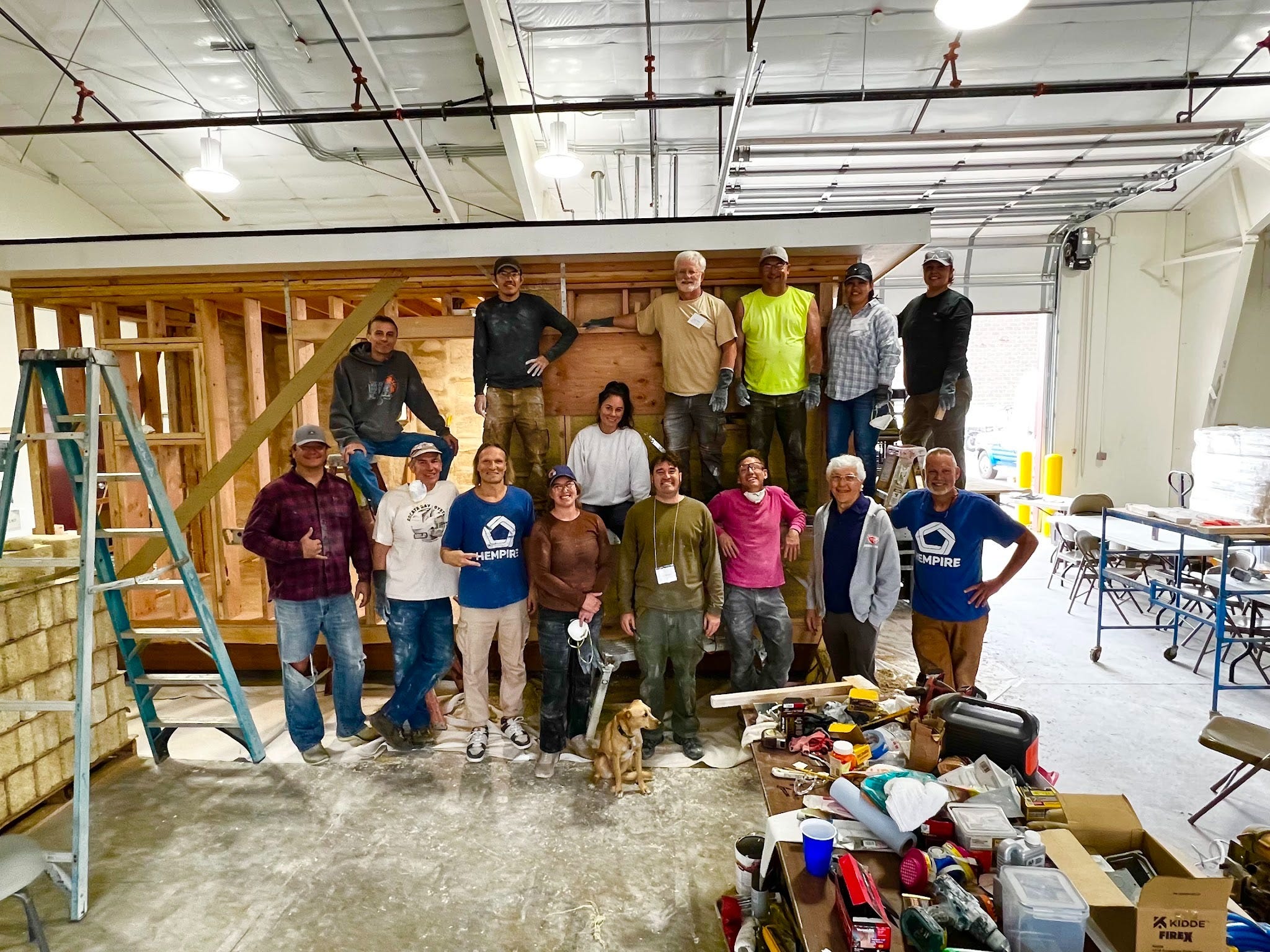
Wade Atteberry did not build the OSU demonstration alone. And that is precisely what makes his role in it worth understanding.
His contribution was not simply putting materials into walls. It was bringing together experience from several parts of an emerging industry—builder, patent holding inventor, researcher, developer, manufacturer and educator—and using that experience to coordinate a project in which very different hemp technologies could be experienced side by side.
Around him was a larger constellation of knowledge: Oregon State University and its researchers and faculty, including OSU professors John Simonsen, PhD and Jeffrey Steiner, PhD; manufacturers bringing emerging products and equipment; builders and crew members turning those technologies into physical assemblies; and Indigenous participants learning through the hands-on Train-the-Trainer program.
Inside one small structure, agriculture met construction.
Research met field experience.
Manufacturing met craftsmanship.
And education connected them.
For Atteberry, that educational piece is essential:
“If people don’t know about it we can’t build with it. If architects and designers don’t know about it, they can’t implement it. They can’t offer it to their customers. And if the people don’t know to ask about it, then it’s never going to happen.”
That is what gives the Train-the-Trainer model significance beyond a single five-day workshop: knowledge learned through building can be carried outward and taught again.
That may ultimately be the most important thing the workshop demonstrated.
Not that one hemp system has solved the future of construction. Not that every material shown belongs in every building. But that an emerging industry can begin to move forward when the people developing the materials, studying them, manufacturing them, building with them and teaching others how to use them have opportunities to work together.
The 10-by-20-foot structure is modest.
The questions surrounding it are not.
Can carbon-negative agricultural feedstock become reliable building products?
Can increasingly sophisticated manufacturing processes make those products more accessible without losing the practical knowledge required to use them well?
Can universities help connect field experience with research and professional education?
Can training expand alongside manufacturing capacity?
And can the infrastructure surrounding these materials—codes, capital, supply chains, skilled labor and market knowledge—develop quickly enough to support what the technologies are beginning to make possible?
The OSU workshop did not answer all of those questions.
It did something perhaps more useful.
It made them tangible.
This month-long build project culminated when — for one week, the walls became a classroom, a laboratory and a meeting place between different stages of an industry still taking shape.
The people have dispersed now.
The building remains.
And so does what it represents: a physical record of a moment when hemp construction could no longer be reduced to a single material, a single method or a single idea.
The next chapter will depend on what happens beyond those walls—in farms and processing facilities, manufacturing plants and design offices, classrooms and construction sites.
The building is finished.
The work of building the industry around it is just beginning.
A Special Thanks from Wade Atteberry
“A very special thanks to Dr. Jeffrey Steiner, Director of Oregon State University’s Global Hemp Innovation Center, and Dr. John Simonsen, Professor of Wood Science & Engineering at OSU, for their vision, leadership and commitment to advancing industrial hemp research, education and innovation. Bringing this workshop together—and creating a space where builders, manufacturers, researchers and future trainers could learn from one another through hands-on work—was no small undertaking. I’m deeply grateful to Jeff , John and the build crew for trusting me to help bring this demonstration to life, and for the work they continue to do to move hemp building forward.”